 Click the picture to view the list
of 71 Civil War VeteransDEAR FRIENDS OF ROSELAWN
We will be spotlighting World War I in March 2026 - its origins, participants, nature of combat, and conclusion.
Roselawn is the final resting place of numerous WW I Veterans, and each is honored and commemorated for their service to our country.
"All Gave Some, Some Gave All".
2018 marked the 100th anniversary of WW I, and Roselawn held an unveiling ceremony, the culmination of efforts to obtain headstones for the 12 unmarked graves of WW I Veterans.
Also, the remarkable story and photo of WW I Veteran James Forrest Law are featured this month, along with his service in the Balloon Squadron.
WORLD WAR I
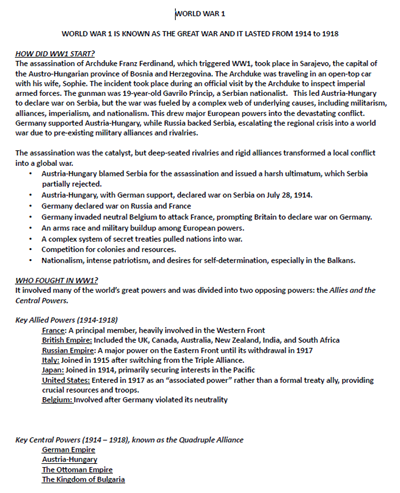
Please find the following overview of World War I, covering its origins, participants, nature of combat, and conclusion.
OVERVIEW & ORIGINS
Known as the "Great War," World War I lasted from 1914 to 1918. The immediate catalyst was the assassination of Archduke Franz Ferdinand in Sarajevo by Gavrilo Princip. However, the conflict was fueled by underlying issues, including militarism, complex alliances, imperialism, and nationalism. What began as a regional crisis between Austria-Hungary and Serbia escalated into a global war as major powers like Germany, Russia, France, and Britain were drawn in by treaty obligations.
PARTICIPANTS
The war divided the world’s powers into two main groups:
The Allied Powers: Primarily France, the British Empire, the Russian Empire (until 1917), Italy, Japan, and the United States (entering in 1917).
The Central Powers: Consisting of the German Empire, Austria-Hungary, the Ottoman Empire, and the Kingdom of Bulgaria.
NATURE OF THE CONFLICT
World War I is remembered for its brutal conditions and significant technological advancements in weaponry:
Trench Warfare: Soldiers endured harsh, unsanitary conditions in long, narrow ditches, facing disease and psychological strain.
New Weaponry: The war saw the introduction of the flamethrower, poisonous gas (leading to the 1925 Geneva Protocol), and the tank, which was developed to break the stalemate of trench warfare.
CASUALTIES AND CONCLUSION
The war resulted in an estimated 15 to 22 million deaths and nearly 40 million total casualties. The conflict ended following the Armistice on November 11, 1918, after the military defeat of the Central Powers.
The formal peace was established by the Treaty of Versailles (1919), which included:
1. War Guilt Clause: Germany accepted sole responsibility.
2. Reparations: Massive payments to the Allies.
3. Territorial Losses: Germany surrendered Alsace-Lorraine and its colonies.
4. Military Restrictions: Significant limits were placed on the German military.
5. League of Nations: Established to prevent future global conflicts.
JAMES FORREST LAW: WW I BALLOON SQUADRON - “UP IN THE AIR”
Submitted by:
Patricia Talbott-Crump –Published in The Hearts & Souls of Roselawn
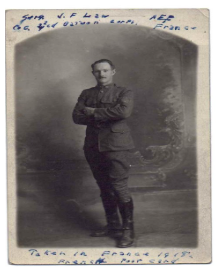 James Forrest LawAt the age of 28, James Forrest Law emigrated from Grofthead, Scotland, to America. He eventually settled in Lexington, Missouri, where he married Mattie L. Weedin. The couple had seven children and later resided in Pueblo, Colorado, living at 1624 Carteret Avenue from 1902 until the early 1930s, then at 1129 East Orman until 1946.
At age 50, Jim served his adopted country with the same dedication as men much younger than him. While family records do not detail exactly why he volunteered, he served in France with the American Expeditionary Force (AEF) in Company C of the 22nd Balloon Squadron. His service remains a unique and vital part of our country’s WWI history.
The AEF, established in July 1917 under General John J. Pershing, fought alongside French and British troops against the German Empire. They played major roles in the Aisne, Saint-Mihiel, and Meuse-Argonne Offensives. Central to these operations were observation balloons, which served as aerial platforms to gather intelligence on enemy movements and artillery.
These balloons were typically filled with hydrogen and tethered to steel cables, reaching altitudes of 3,200 to 4,900 feet. Because they were highly flammable and served as primary targets for "balloon buster" pilots, observers often had to jump from their platforms using primitive parachutes. This dangerous duty allowed artillery to engage targets far beyond the visual range of ground-based observers.
By the end of the war, 110 balloon companies had been created, though only 35 went to France with the AEF. Seventeen of those companies served at the front, making 1,642 combat ascensions.
After the war, Jim returned to Pueblo and worked as a machinist until his retirement. He passed away in 1946 at the age of 78. He is buried at Roselawn in Block 22 alongside his wife, Mattie, and their daughter, Rose. We remain proud of Great Uncle Jim’s history and his service as a WW I patriot.
NOTE:
Each Veteran who has served our country deserves to be remembered and honored.
With the passing of time, fewer and fewer of our Roselawn Veterans who served in the Civil War, Spanish American War, and WW I are remembered.
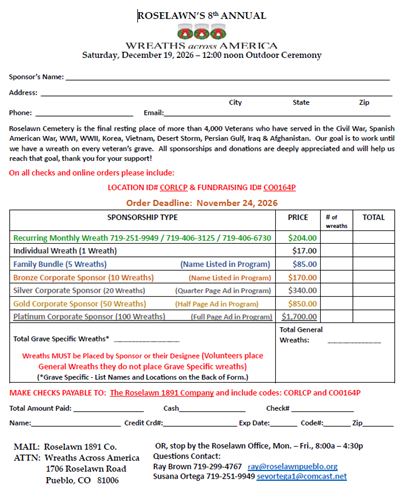
Our 2026 goal is to have a wreath for every one of the 4,000 Veterans laid to rest on our Sacred Grounds.
LET'S REMEMBER...............the words of Benjamin Franklin, "One can tell the morals of a culture by the way they treat their dead".
If you are a "History Buff," the expanded, lengthy version of World War I's history is provided as an attachment, as well as the WAA Sponsorship Form.